
People say we’re not doing enough enmadden me. “We,” my fellow engaged Americans, are standing on street corners, calling their congresspeople, filing lawsuits, boycotting businesses, talking and waiting for people who have gone Maga to… More
A Coalition of Coalitions
Hope Is Not Your Pet Bird
I am too depressed to drink wine. If you know me at all, you should be alarmed. Don’t worry. I will force myself to have a glass so I don’t sink further into the abyss. I’m not sure if I’ve actually been depressed before. The symptoms are lethargy, sleeplessness, and a general lack of hope, correct? I went to sweep the deck and porch today and my back hurt immediately. My back doesn’t hurt! I’m not a back hurter! A hurt backer! I can lift my weight in kitty litter!
I’m working to build a group of like-minded folks, women for now, to serve as a kind of clearinghouse for other coalitions. Once a month, we’ll gather to share what good activism or community building we’ve seen, heard of, or been involved in. This coalescing, as I call it, is meant to buoy us and to stave off further depression, but it’s also to knit together a strong fabric of resistance in case things get much worse.
I didn’t think this would happen. I believed Kamala would win. I knocked on doors. Everyone I talked to said they either were or already had voted for her and Walz. I traveled to Florida. To other parts of Arizona. I saw the Tiktoks and the rallies. From my narrow perspective, I had no doubt sanity would prevail.
I do this often though. I believe based on some evidence, but not enough evidence. I didn’t know how fully the right wing media bubble had encircled Republicans. I didn’t know how little corporate media cared until after the election that Trump was 100% OK with Project 2025. I had hoped my fellow countrymen were good, thoughtful people. I was wrong.
I wrote a short essay for Torrey House Press who has a blog called “A Thing with Feathers,” referring to the Emily Dickinson poem, “Hope is a Thing with Feathers.” Hope does lift us up. But it also threatens to drop us to the ground, where we bash our skulls against the rocks.
The whole poem goes like this:
“Hope” is the thing with feathers –
That perches in the soul –
And sings the tune without the words –
And never stops – at all –
And sweetest – in the Gale – is heard –
And sore must be the storm –
That could abash the little Bird
That kept so many warm –
I’ve heard it in the chillest land –
And on the strangest Sea –
Yet – never – in Extremity,
It asked a crumb – of me.
I’ve been stuck on that last line for about 30 years. Although I majored in poetry, I am not always good at paraphrasing. But it finally came to me. At least I came to know what I think the ending means. It means hope is not a goddamn pet. It does its work but its work isn’t light and fluffy. Its cold, strange, and endless. It asks nothing of us, which means it is not our friend. Beware, endless optimism. Election night will fly right on by.
I’ve known the vast swath of problems that Kamala was up against.–For the past 9 years, we’ve worked to try to lift Arizona education from raking next to last in per-pupil funding. We tried to raise teacher salaries. We tried to stop vouchers. But because my kids go to public school and because I know so many teachers, I thought we were doing all right, even against the odds. But that was hope. Our education system wasn’t broken until the right tried to tell it was broken (aka No Child Left Behind) and then they began to defund schools, advocate for school choice, invent voucher systems so the public schools were starved. They fulfilled their prophecy and now kids in public schools do suffer. Not that home schooled kids or private school students do better. We’ll never know because they’re absolved from testing.
Whether because they don’t know how to research, have no critical analysis skills, or a just plain incurious, the billionaires (Musk, Theil, Mellon, the last Koch bro,) who worked to elect Trump repeated lies and obscured facts. From “they’re eating the dogs, they’re eating the cats” to “Trump doesn’t even know anything about Project 2025” to “Tariffs are great” and “let’s deport 15 million people” (many of whom grow our food, slaughter our animals for meat, and who pay taxes yet receive few benefits from those taxes), they thought Trump was joking or we were lying or he would’t really do that. Or they just weren’t curious enough to find out if he meant it. Or worse, they didn’t care. Or much worse, they are looking forward to finally getting revenge on those of us who aren’t miserable, incurious, or disgruntled with our lives.
I’m reading Hannah Arendt’s “Eichmann in Jerusalem.” Adolf Eichmann facilitated the deportation of Jews, originally organizing their emigration, lastly, organizing their transportation to concentration and death camps. Arendt writes about the spectacle of the trial. By contextualizing its performative aspects, Arendt’s underpins one of the arguments of the essay. Empty people will perform their roles until their roles define them. Eichmann, not a scholar or a business success, did not have much going for him. He didn’t have strong beliefs. He wasn’t curious. He wanted to rise up. He found a ladder called Nazism that allowed him to believe in something. He didn’t care what that belief was, necessarily. The apparatus of the system filled him up. It’s not quite a tale of how ordinary men become killers of six million Jews. It’s a tale of how an ordinary man thought people should see him as extraordinary. “Well, the misfortunes were ordinary. Since he “had not exactly been the most hard-working” pupil—or, one may add, the most gifted—his father had taken him first from high school and then from vocational school, long before graduation,” Arendt writes. He would perform extraordinary acts until the acts defined him.
When he joined the Nazi party, his fortune and his status as an ‘ordinary’ man would soon change. “Actually, things had taken a turn for the worse somewhat earlier. At the end of 1932, he was unexpectedly transferred from Linz to Salzburg, very much against his inclinations: “I lost all joy in my work, I no longer liked to sell, to make calls.” From such sudden losses of Arbeitsfreude Eichmann was to suffer throughout his life. The worst of them, he explained to Captain Less, occurred when he was told of the Führer’s order (always officially called, to indicate its preëminence among his orders, the Führer Order) for the “physical extermination of the Jews,” in which he was to play such an important role. This, too, came unexpectedly; he himself had “never thought of such a thing, such a solution through violence,” and he described his reaction in almost the same words: “I lost everything, all joy in my work, all initiative, all interest; I was, so to speak, blown out.” An ordinary job with an ordinary firing. But the rub is, that his testimony doesn’t comport with his history. He claims he was glad for the firing, for it led him to his significant position in the Nazi apparatus. But Arendt doesn’t buy it. “A similar blowing out must have occurred in 1932 in Salzburg, and from his own account it is clear that he cannot have been very much surprised when he was fired, though one need not believe his testimony that he had been “very happy” about his dismissal.”
Disgruntled people blame other people for their gruntling. There has been an evacuation of intelligence–public school decimation, drugs, and mind-numbing technology (smart phones are another opiate of the masses). By de-emphasizing the importance of intelligence, which here I mean only curiosity and a bit of common sense, the right wing media can play fast and loose with facts because no one cares about them. Why look up whether this or that fact is true if you can watch a very talented person stack fifteen milk crates high to see if they can stand upon them? (Reader. They cannot.) Passively observing videos of pranks gone awry, does not help people find “arbeitsfreude.” (Nice raveling, Ms. Arendt. Arbeit macht frei). It doesn’t even help you get arbeit at all. Being underemployed or employed as a cashier at two jobs will make someone disgruntled. And who are you going to blame. The people who aren’t complaining. The people with joy. The people with hope.
It’s not as if he was driven enough, or really smart enough, to engineer an entire program of genocide. His ideology didn’t come before the Nazi party. “”But bragging is a common vice. A more specific, and also a more decisive, flaw in Eichmann’s character was his almost total inability ever to look at anything from the other fellow’s point of view.” He talked big, claiming he himself killed five million Jews. “Bragging was the vice that was Eichmann’s undoing. It was sheer rodomontade when he told men working under him during the last days of the war, “I will jump into my grave laughing, because the fact that I have the death of five million Jews [or “enemies of the Reich,” as he always claimed to have said] on my conscience gives me extraordinary satisfaction.” He did not jump, and if he had anything on his conscience, it was not murder but, as it turned out, the fact that he once had slapped the face of Dr. Löwenherz, head of the Jewish Community in Vienna, who later became one of his favorite Jews.” He also claimed he wasn’t an anti-semite! Can we add lack of self-awareness, a propensity for bragging, and a habit of dissembling to the disorders of our dear electorate?
They supplied it. They supplied all the tools. The trains. The stamps. The urgency. Arendt, “Rather, “it was like being swallowed up by the Party against all expectations and without previous decision,” he said in court, adding, “it happened so quickly and suddenly.” He had no time and less desire to be properly informed; he did not even know the Party program, and he had not read (as he never did read) “Mein Kampf.” Kaltenbrunner had said to him, Why not join the S.S.? And he had replied, Why not? That was how it had happened, and that was about all there was to it.
Of course, that was not all there was to it. What Eichmann failed to tell the presiding judge in cross-examination was that he had been an ambitious young man who was fed up with his job as travelling salesman even before the Vacuum Oil Company became fed up with him, and that from a humdrum life without significance or consequence the wind had blown him into History, as he understood it; namely, into a Movement that always kept moving and in which somebody like him—already a failure in the eyes of his social class, in the eyes of his family, and hence in his own eyes as well—could start from scratch and make a career. And if he did not always like what he had to do (for example, dispatching people to their death by the trainload instead of forcing them to emigrate);”
So much stems from boredom, disgruntlement, and lack of curiosity. “The aggressions of the regime, which had at first been directed primarily against “anti-Fascists”—Communists, Socialists, left-wing intellectuals, and Jews in prominent positions—had not yet shifted entirely to the persecution of the Jews qua Jews.” Holding a loaded gun and spinning in circles until something provokes you to shoot someone in particular. No real basis for antisemitism. The target is convenient. The interest in one’s own ‘suffering’ is the root cause and the only theoretical underpinning.
Eichmann wasn’t the only disgruntled German. The ‘they’ of the tools. The trains. The stamps. here are thousands of disgruntled complainers who created a system where they could accuse an entire group of people of taking their chance for success away. They called them elitists. Possibly because they could speak and they could read. ““Officialese [Amtssprache] is my only language.” The real point here is that officialese became his language because he was genuinely incapable of uttering a single sentence that was not a cliché. (Was it these clichés that the psychiatrists thought so “normal” and “desirable”?”
“the longer one listened to him, the more obvious it became that his inability to speak was closely connected with an inability to think; that is, to think from the standpoint of somebody else.”
We had no idea that people in our country could not tell right from wrong. We were fools. Arendt writes about Eichmann’s trial. “And the judges did not believe him, because they were too good, and perhaps also too conscious of the very foundations of their profession, to admit that an average, “normal” person, neither feeble-minded nor indoctrinated nor cynical, could be perfectly incapable of telling right from wrong.”
“et Eichmann’s case is different from the case of the ordinary criminal, who can shield himself effectively against the reality of a non-criminal world only within the narrow limits of his gang. Eichmann needed only to recall the past in order to feel sure that he was not lying and that he was not deceiving himself, for he and the world he lived in had once been in perfect harmony. Eighty million Germans had been shielded against reality and factuality by exactly the same self-deception, lies, and stupidity that had now become ingrained in Eichmann’s nature.
Not only is Arendt’s article about the banality of evil or Eichmann’s self-deception and his displacement of responsibility. But even those of us who try for curiosity, empathy, and knowledge are prone to self-deception too. We are fools too. We believed that people were mostly good. We believed that people wanted an education. We believed in innate curiosity. We, like the Jews, don’t believe things will get that bad. “They lived in a fool’s paradise, in which, for a few years, even Streicher spoke of a “legal solution” of the Jewish problem. It took the organized pogroms of November, 1938—the so-called Kristallnacht, or Night of Broken Glass, when seventy-five hundred Jewish shop-windows were broken, all synagogues went up in flames, and twenty thousand Jewish men were taken off to concentration camps—to expel them from it.”
How do you balance hope with reality? Remember, that bird doesn’t need you to feed it. Hope is persistent. So should our coalescing and community building be. So should our self-analysis be. It’s hard to keep our egos in check. I’m done with Arendt for a bit. I’m going to see if a glass of wine makes me feel better, while remembering that feeling better isn’t the only work to be done.
It’s Not Hope but It’s the Beginning of a Plan
On election day, I took my dogs on a walk and finished listening to the audiobook Parable of the Sower by Olivia Butler. This dystopian story begins in 2024 with a slightly-worse-than-it-is-right-now vision of Los Angeles. The middle class have built walls around their neighborhoods. The poor have no homes, sell their bodies and drugs to survive. But in the book’s version of 2025, then 2026, things get worse: angry mobs, high on a drug called ‘pyro,’ crushes through the neighborhood’s defensive walls and sets whole communities on fire. Eventually, our narrator, Lauren takes to the road, cultivating a small group of people she can trust as they try to survive with only 3 guns, a little cash, and some dried meat and fruit between them. I won’t spoil the end of the book, but I will say, this group coalesced into a community that might survive in a place with a little water and some fruit trees.
Tuesday, I had meetings and manuscripts to read. I made oven fried chicken thighs and mashed potatoes. I cook when I’m nervous. That day, we ate at 4:15. Later that night, with my friend B, I went to the Orpheum where the Democrats hosted what we thought we be a celebratory event. I cheered Susan who I met when she and I organized a rally for Proposition 139—the Arizona Abortion Access initiative—in Flagstaff. We’d gathered in front of city hall with friends like Sanjam, Angie, Ann, Rima, Julian, Emma, Joan, and Erik. I starting work for reproductive rights after an essay entitled, “My Abortion at Age 11 Wasn’t a Choice. It Was My Life,” that I wrote for The New York Times after the Dobbs decision came down. Publishing this piece opened paths for me to work with bodily autonomy advocates like Maggie in Washington DC, Andrea in Florida, and Jasmine in Arizona. I gave interviews to print and television reporters: Haruka, from Tokyo, Maria from Valencia and the amazing Valentine from Paris. I told my abortion story on stage along with other abortion storytellers—another Nicole, Liz, Matt, Dominic, Nilsa, and Dr. Caren. After our presentation, I attended the after party. Dozens of women came up to me to introduce themselves, to tell me their abortion story, to share with me about the story about the time they experienced sexual assault, to thank me for putting my story out there. I’ve had the same experience at every event where I’ve shared my story. Others share their back.
Tuesday night, at the Orpheum, I said hello to Shonto. I ran over to Aubrey to give her a huge hug for winning her election. Jonathan spoke to the audience to tell us how Apache had run out of ballots, so they were trying to figure out how to get more. James grasped my hand. Pamela patted my shoulder.
As the votes came in, the mood shifted. B and I left before we could see what would happen in Pennsylvania. We shared a cigarette. I hadn’t smoked in over 20 years but tonight seemed like a good night to start again. I came home and found my husband scrolling and scrolling. I said, “Your eyes can’t change the news,” but he couldn’t stop trying to make it so. I took a melatonin and tried to sleep. In the morning, my son came upstairs and squeezed my shoulder. “I’m sorry, mom.” I told him I was sorry too.
On Wednesday, I moved like molasses. My body didn’t want to enter the day any more than my mind did. It took me a while to get it together, but I managed to walk the dogs. Not only did I have to stop the storm of ideas in my head—I have to move. I have to buy a gun. I should get seeds. The characters in Parable of the Sower wished they had packed more seeds—but, because I finished that book, I needed a new one. I started Naomi Klein’s 2014 This Changes Everything: Capitalism versus the Climate. I knew it would be at least as depressing as I felt. 10 years ago, we needed to act full-throttle, full-throated on climate change. But then, we elected Trump two years later. Now we have him again. A dark hope rises in me that he will drive us to the brink where we finally see into the abyss and our mindset is collectively and purposefully shifted. But I shrink from that darkness because we’re just as likely to fall headfirst into the abyss as we are likely to change our fossil fuel-ish ways.
I came home and read Alison’s manuscript, The Rejection Lab. Sarah, my co-editor at the University of Georgia’s Crux series, and I thought today would be a good day to read about rejection, race, dating, Benjamin Franklin, Cotton Mather and the whole history of trying and losing. At 11:00, I realized I was going to be late for work. I rushed around getting ready, which was the only time I hadn’t felt near desperately sad. Panic is a good distraction from sorrow.
I made it to school with a minute to spare. I thought I was OK but when I walked into the faculty meeting, I burst into tears. Seeing my friends, Monica, Angie, Karen, Geetha, Oscar, Erica, Bill, Christine, Calinda, made the election results real. I felt their sadness. I reckoned with my own. I streamed tears while we discussed new Annual Review policies. They’re not called Annual Reviews anymore, was the upshot.
I had to run to teach my class. I almost cried when I saw my intermedia creative nonfiction students but kept it together. The students knew I’d been working hard on the election, even as I hadn’t directly told them what my politics were, because that’s against the rules. But it’s not against the rules for them to guess. They looked at me with pure empathy. And so, did I. They would have to live longer with this travesty that me. Still, we were there together for that hour. I was so grateful for the essays we read. They were brilliant—each one differently so—one was about a rug, another about the ocean, another about bones, another about where our old laptops go to die. For 75 minutes, I felt a reprieve. Then, I had a beer with Sherwin Bitsui. Then I went to dinner with my husband and son. Then, Lawrence and I had a glass of wine.
That evening, we faculty attended a talk by Sabah. I saw Jeff, KT, Bjorn. We nodded at each other, as if to say, “Can you believe we made it to a talk after what we’ve been through today?” “Yes. And in fact, I’m glad you’re here.”
There are a lot of names in this story. I drop them on purpose. These are people who, if we had to walk a long road north from LA, that I would trust to have with me. These are people who are going to stand up for me, for our trans and gay brothers and sisters, for voting rights, for bodily autonomy, for working to act on the climate crisis. These communities will band together. They will listen to my stories and tell me theirs. We are locked arm in arm. They can try to break us up, but are links are strong.
Of democracy and the climate, technology is not going to save us—not polling technology or internet technology or SpaceX or coating the atmosphere with a thin layer of sulfur dioxide. What’s going to save us is stories of this goofy, beautiful world—stories like Gary Kristensen who road 48 miles in Oregon in a boat made of a pumpkin. What’s going to save us is the story of the dams coming down on the Klamath where now salmon spawn in their ancestral grounds. What’s going to save us is your story and my story and Alison’s story, Grace’s, Ben’s, and Hayden’s. We build our communities by telling our stories. My hope lives because we keep telling them.
10 Questions the Media Should Have Asked
10 Questions I Wish the Media Asked Trump
- Who is your primary boss? Putin? Xi Jinping? Orbán? Musk? Bezos? Thiel? Who am I missing?
- Have you stocked up on paper towels? Hurricanes are coming in hot and fast, and we’ll need you to toss the drowning a couple of rolls.
- A new bird flu is adapting, recently jumping from chickens to pigs. Should we inject ourselves with bleach or Ivermectin now or later?
- When the mass deportations begin and we hide our house keepers and gardeners in our homes, will the police storm the front door or the back?
- Since women will be imprisoned for abortions and miscarriages, what private prison stock do you recommend?
- Additionally, after you dismantle the department of education, won’t it be cheaper to turn schools into jails so the preschool to prison pipeline in perfectly streamlined?
- On campus today, a young man shouted, “Your body, my choice” at my daughter. Are they effectively married now?
- On a different campus, a young white man shouted at a Black student, “The cotton fields need picking.” Do you think we should ban the cotton gin so Black people can get those Black jobs?
- When you stop sending social security checks, will you provide retirees who paid into social security with a tent and maybe a sleeping bag for when they lose their homes.
- When you revoke the $35 insulin cap so pharmaceutical companies can again charge $800 per month to diabetics, will you provide a small tax credit to help pay for funerals?
How It Started. How It’s Going: The Story of the Purple House
In late September, after Erik and I deposited our daughter, Z, at the University of Arizona, we fell in love with the neighborhoods around the university. Sam Hughes, an historic district with houses covered in stucco and topped with Spanish tiles and sporting old wooden doors built from wood imported from Mexico, was beyond our price range. But the neighborhood just a little north from campus, Blenmen Elm, had a few houses that fit our budget. We drove by a few houses but didn’t look inside any. When we returned to Flagstaff, my BFF, B, put me in touch with a realtor. He toured a few houses for us using FaceTime. He found one that was in our price range but needed a little work. And, it was purple.
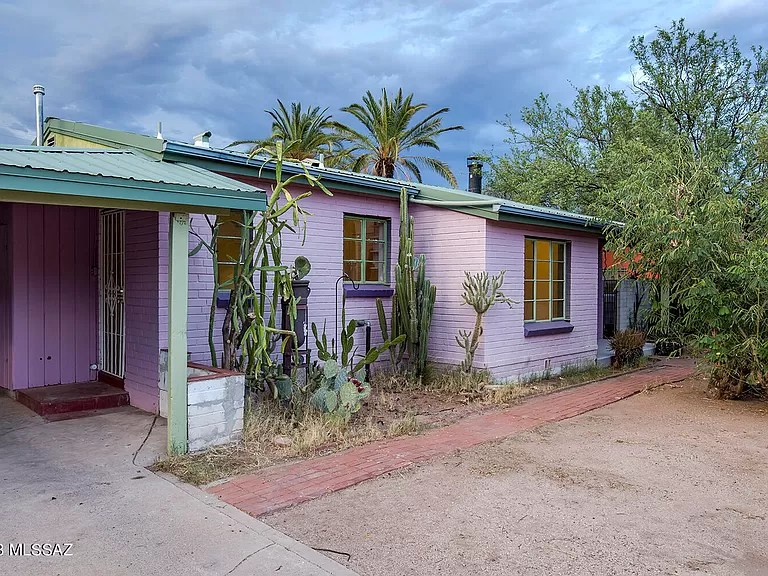
Or, perhaps you would call it lavender. I don’t know what kind of people buy a house via Facetime, but apparently, we are those people. The house had so many highlights: Close to U of A Neighborhood, 3 beds, 2 baths, a big back yard, a patio, an orange tree, a pomegranate tree, and a dragon fruit plant, plus a bunch of cacti. It is possible I wanted the house for its flora, but I also loved the blue and orange tiles on the counter in the kitchen, the wood floors, the fireplace. We put in an offer. I drove down on a Thursday for the inspection scheduled for that Friday. I came back on Saturday to prep for teaching the next Monday but the short trip not only afforded me a chance to see the house in person, but to see Z.
But, the inspection was hard on me. There were problems. The facia and soffit. The gutters. The house, upon looking at it more closely, was grimy. But nothing was really a deal breaker. Our realtor worked with a handyman who could do a lot of the repair work. And there is nothing I like more than cleaning. Or, so my children tease me. The living room needed almost no work, except for a new door, and, eventually, new windows.



The kitchen was another story. I actually liked the orange-lined cabinets and drawers because they echoed the orange in the tiles. But the paint had worn thin and had suffered the scuffs of time. But we wanted to save as much as we could of the original character of the place. Otherwise, why buy an older home? So J, our realtor’s handyman, painted them blue. His wife scrubbed the black handles to reveal they were actually brass. He also painted the walls and ceiling and tiled the floor with satillio, but the functionality of the kitchen was not tied to paint or flooring. The fridge didn’t work and the stove was old. There was no dishwasher or disposal. There were hookups for a washing machine in the carport but the carport didn’t seem like a very clean place to do laundry. Home Depot had a bundle sale going and we bought a washing machine, dryer, dishwasher, disposal, refrigerator, and new range hood.
J installed the appliances for us. There was even a spot for the dishwasher, although it was on the far side of the kitchen away from the sink. Z and her friends, who were living in the dorms, were most immediately excited about the washing machine. One night, Z and her friends went over to do their laundry, then promptly left for Target. When J came the next day, the tiles he had just laid were broken under the washing machine. Z was in trouble for leaving the washing machine alone while she went to Target, but it wasn’t really her fault. Erik called a guy to come look at it. We thought he fixed it and then my in-laws and I went down to work on the house and the washing machine still jumped like beans. With a little research, I found that we had indeed not removed the SHIPPING BOLTS. The instructions for installation shouted these words loud, but having not been there when Home Depot delivered them, perhaps we assumed they had already been removed? Perhaps reading instructions is many people’s strong point.
J retiled and repainted. A few weeks later, my mother-in-law dusted and washed and organized the dishes we brought down into the cabinets. My father-in-law took the tape that held the fridge together and, happily, it didn’t collapse into piles at his feet. Now, the purple house has a kitchen so functional one could actually cook in it. And do dishes.



J also repaired several broken countertop tiles with ones I found on eBay that matched the beige ones. Fortunately, none of the orange and blue tiles were broken. The next biggest project was the kind you can’t see, but matters most. A swamp cooler was the only cooling system the house had–we had an evaporative cooler in Salt Lake, where it worked marginally well, but Salt Lake doesn’t get big monsoon storms like Tucson. Tucson turns humid after rain. An old gas furnace took up a lot of room in the hallway to the back bedroom. So for efficiency and efficacy, we had a heat pump installed, which can heat with far less energy than a gas furnace and that can cool the air so it is actually cold.
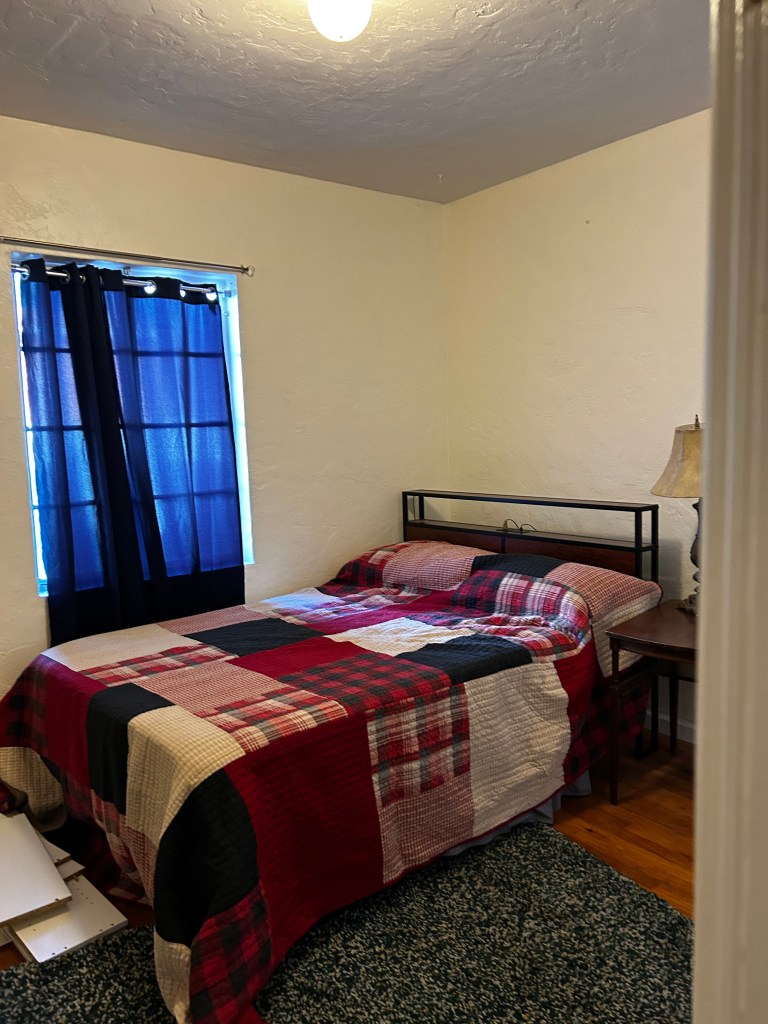
Another room that seemed challenging was one of the back rooms. It was painted red. Dark red. All red.

Not everyone hates a red room but if you want to sleep or study or do anything besides foment anger, red doesn’t seem the best color. I admit. I’m boring. J had to paint not only two coats of primer but two coats of regular paint. There was a pink stage that was kind of lovely, in a Pepto Bismol kind of way. Still, I’m boring and now it’s cotton white.
Speaking of Pepto Bismol, the bathroom had exciting colors too.

Pink and green might not be so bad, but the colors distracted from a cadre of sins. The floor was bad. The toilet and bath stained yellow. I spent two full days scrubbing the bathtub and toilet with CLR but in the end, it was extra-strength vinegar that removed the yellow stains around the sink faucet and rust and soap stains on the soap dish.

We did not remove the Grateful Dead tile, however.

Also, I bought Trefoil-flavored body wash. A mistake, I admit. No one wants to smell like butter and vanilla all day.
The second bath was in worse shape than the main. A shower insert. A vanity from the sad aisle of Home Depot. Another stained toilet. This space needed to be gutted, especially because drywall covered a 4 foot by 4 foot space that had just been lost to bad remodeling or pretty good hiding of a marijuana operation.


J took the wall down, jackhammered a new drain, and tiled the shower with these cool tiles Erik chose.

Which you can’t really see here because Z has a lot of hair products. Still, new shower faucet, little shelves! The floor is also covered in cool tile but I forgot to take a picture of it. And, the vanity has ALMOST enough space for the rest of Z’s beauty products.

I’m still working on de-staining the toilet. More vinegar, please!
The back room was one giant cavern. It might have been good for an office or maybe an extra large workout room. Or a place to destem your marijuana plants that you’d grown in the bathroom’s hidden wall before growing your own became legal.

Erik and I waffled too long on the flooring. We should have asked J to lay tile. But now, it’s too late because Z has moved in and heavy furniture sits upon the concrete floor. We did what we could to hide the floor with rugs and cute items. It’s an ongoing battle.

The last thing we did before we drove back to Flagstaff was to ask the neighbor’s landscaping guy if he’d come do our yard. It has never been this organized. I’m happy not to be the messy yard people anymore! Also, J completely lifted up the walkway bricks, flattened the underlayment, and re-bricked in a cool pattern.

We probably spent more money on the house than we intended and I probably inhaled too much concentrated vinegar, comet, CLR (calcium lime rust remover), but the purple house is truly one of my favorite places. It has a good feeling. A good yard. And is pretty clean! I’m excited for Z’s roommates to move in although I’m going to miss sitting in the backyard, watching the hummingbirds flit to the pomegranate flowers. I bet, if I don’t mom it up too much, they will even let me visit.
No more Novembers?
I haven’t been the same since I lost Zane. Which is OK because I was a fool then. I’m probably still a fool, but a little quieter.

I’m going to let these guys talk for me from now on. They can also change the toilet paper rolls from now on.

Fools of toilet paper. Fools of tile and grout. Fools of cats named Pico and Fools of cats named Trout.
Falstaff was the fool that helped Henry the IV become Henry the V.
Lear’s Fool knew better than the King himself where love and truth overlapped and where they parted.
My friend Peter Friederici wrote a book about not so much changing the narrative but changing from narrative to dramatic story. Narratives are plotted and finished. If the Climate story is a narrative, we know how it ends. Tragedy means we had a choice in the way of our fate, buta tragic flaw means that we cannot escape our fate, even if there was a moment for the tide to turn. A drama conspires with the audience. What they know matter to the story. The Greek Chorus helps them participate. Comedy, even more so, “holds that any people can find agency” (127).
Moments of foolhardiness can be real mistakes–tapping someone on the butt to say, ‘go get ’em’ might feel like abuse. Staying out instead of coming home. Walking in high heels. Telling that joke. Talking too loud. Saying it’s all going to be OK. Saying that it’s not. Letting your kid take the bus. Making your kid take the bus. Driving 8 hours to see your family. Saying you don’t believe in: therapy, drugs (they don’t work), alcoholism, trucks, phones, chicken broth, grades, human evolution (aka, humans are done), water buffalo versus wildebeests, the singularity, makes you a fool. But you have to draw the line somewhere. Take a stand. Overmother your own mother. Take your medicine that you don’t believe in. Make some pies.
Happy Thanksgiving, cats and fools.
What is lost can be remade
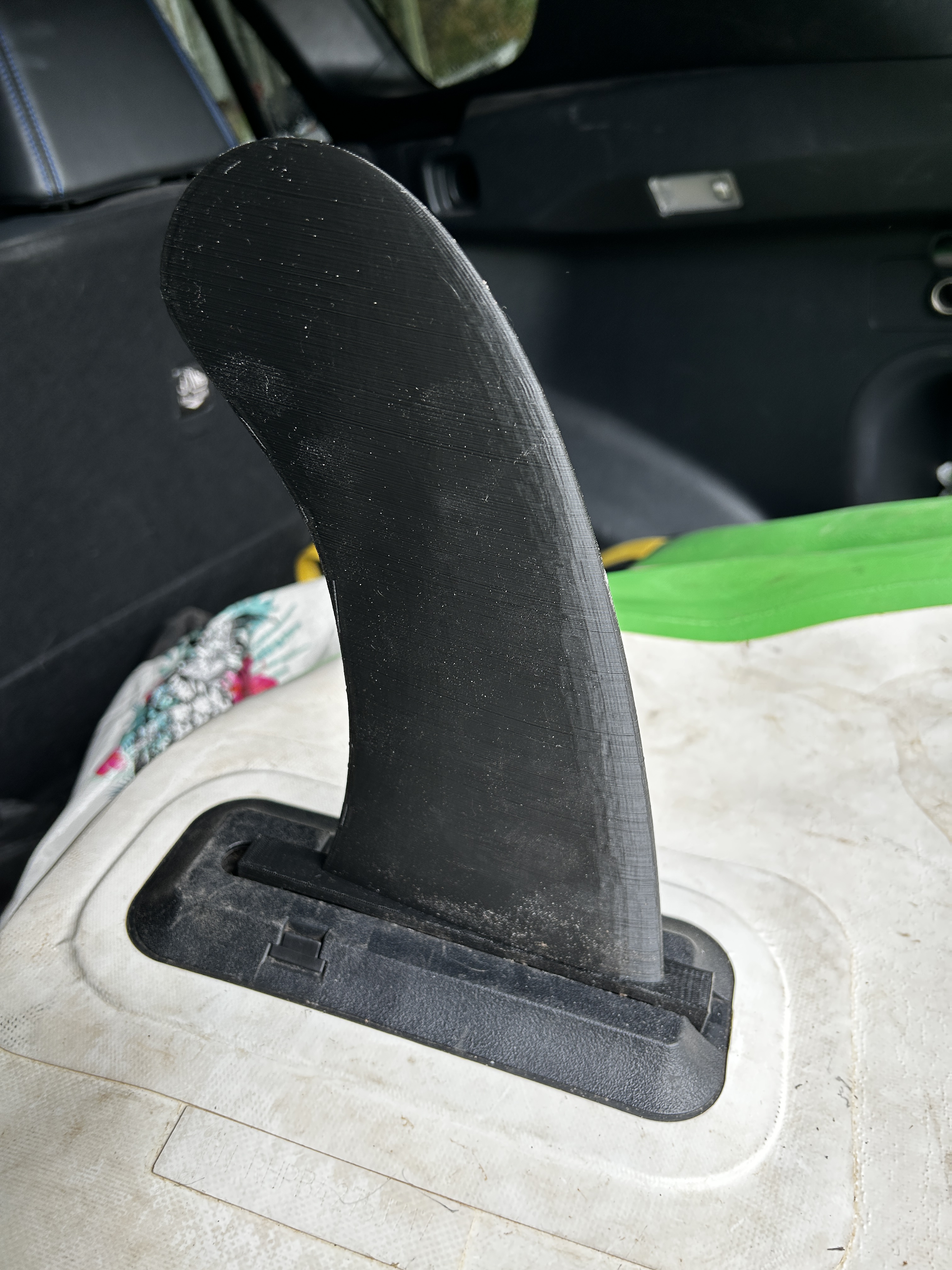
On June 30th, I went with my good friend Beya and our youngest borns, to Clear Creek to Paddleboard. The wind was strong. The water was murky. The sun was hot. We managed to make it around the reeds but no further. When I emerged from the water, I found a horrifying sight. My paddleboard fin had come out of its socket and had fallen to the reservoir floor. Max and Ian searched the mud for it, but it was nowhere to be found. No worries, I thought. That’s what Amazon is for. But this fin is particular. It has little notches to anchor the fin (not so well if you don’t slide the lock all the way through). I called CA Paddleboards. They haven’t made that kind in years. Someone in Utah had just lost his and they’d had to share the disappointing news to him. Erik wasn’t happy. He teased that maybe I could go to the Maker Lab at NAU to get a new one printed. That seemed impossible to me. Farfetched to him. I searched the internet as deeply as the boys searched Clear Creek river. Nada. There was none. So I called the Maker Lab people. I learned Tinkercad. I tinkered and prototyped and screwed up measurements. Zoe kept telling me I needed calipers. Max, who told me when I had almost finished drawing the fin, having bruised my head hitting it against the wall of three dimensional learning, “oh yeah. I learned Tinkercad in science last year.” I made one fin. It was too small. I made another fin. The notches were in the wrong place. I made another fin. The base was too wide. But five prototypes later, I finally have a fin that slides into the notch inside the Paddleboard. Perhaps it will warm up enough for us to make it to the water one more time before winter.

Best books with best titles, alphabetically: a failed attempt to combat insomnia
Appleseed–Matt Bell
Beloved–Toni Morrison (my number one fave?)
Bastard Out of Carolina–Dorothy Allison
Braiding Sweetgrass–Robin Wall Kimmerer
The Beautiful Ones Are Not Yet Born–Ayi Kwei Armah
The Brother’s K–David James Duncan
The Bone People–Keri Hulme
The Color Purple–Alice Walker
Cloud Cuckoo Nest–Anthony Doerr
Control of Nature–John McPhee
Dear Committee Members–Julie Schumacher
Detransition, Baby–Torrey Peters
The Every (Dave Eggers–I didn’t really like but I got stuck on E)
The Echomaker–Richard Powers (thought of my actual favorite E)
The Effect of Gamma Rays on Man-in-the-Moon Marigolds–Paul Zindel
Even Cowgirls Get the Blues–Tom Robbins
Finnegan’s Wake (hahaha)
Flight Behavior–Barbara Kingsolver
Fierce Invalids Home from Hot Climates–Tom Robbins
Franny and Zooey–JD Salinger
Geek Love–Katherine Dunn
Gut Symmetries–Jeanette Winterson
Galatea 2.2–Richard Powers
Heavy–Kiese Laymon
Half Asleep in Frog Pajamas–Tom Robbins
Hamnet–Maggie O’Farrell
H is for Hawk–Helen McDonald
Hitchhikers Guide to the Galaxy–Douglas Adams
Homegoing–Yaa Gyasi
How to Write an Autobiographical Novel–Alexander Chee
I Been in Sorrows Kitchen and Licked Out all The Pots–Susan Straight
It’s Like This Cat–Emily Neville
I’ve Been Down So Long It Looks Like Up From Here–Richard Fariña
I Am the Cheese–Robert Cromier
In the House Upon the Dirt Between the Lake and the Woods–Matt Bell
Jitterbug Perfume–Tom Robbins
The Kite Runner–Khaled Hosseini
Lincoln in the Bardo–George Saunders
Let the Great World Spin–Collum McCann
Light in August–William Faulkner (this might be my second favorite)
Moby Dick–Herman Melville
Master Butchers Singing Club–Louise Erdrich
My Darling, My Hamburger–Paul Zindel
The Night Watchman–Louise Erdrich
Neck Deep and Other Predicaments–Ander Monson
One Hundred Years of Solitude–Gabriel Garcia Marquez
The Overstory–Richard Powers
Poisonwood Bible–Barbara Kingsolver
Persuasion–Jane Austen
Queen of the Night–Alexander Chee
The Quiet American–Graham Greene
The Round House–Louise Erdrich
The Road–Cormac McCarthy
The River Why–David James Duncan
Sometimes a Great Notion–Ken Kesey
Song of Solomon–Toni Morrison
She’s Come Undone–Wally Lamb
Sexing the Cherry–Jeannette Winterson
Snow–Orham Pamuk
Salvage the Bones–Jesmyn Ward
Slaughterhouse Five–Kurt Vonnegut
Stones from a River–Ursula Hegi
Swamplandia–Karen Russell
Things Fall Apart–Chinua Achebe
This Cold Heaven–Gretel Ehrlich
Under the Banner of Heaven–Jon Krakauer
Underground Railroad–Colson Whitehead
A Visit from the Good Squad–Jennifer Egan
Wolf Hall–Hilary Mantel
Xanadu–Olivia Newton John
Yellow House–Sarah Broom
Zen and the Art of Motorcycle Maintenance–Robert Pirsig
Summer Term
Hello from inside of my summer class. I am teaching a short May term class. I love this class. It’s so organized and fast. The students go from 0 to 60 in 3 short weeks. However, because I broke my wrist while dancing too close to the mosh pit at the Built to Spill show in town, it is hard to type. So now that I’ve finished the four hours of commenting I had to mark on student papers, my wrist is not up to writing but if I don’t write, I might go a little crazy. So, I’m off to take some ibuprofen and write about Nina Simone on the Colorado and me and my sister on the road to visit the brine shrimp.
Halloween costumes of years past.
- 1998–Twister (Twister board as toga, spinning device as mortar board.) Party at Craig and Satina’s. Car shot with automatic rifle sometime in the middle of the night. Fortunately, I’m not in it and no one got hurt.
- 1999–Costume? This is the one year I can’t remember. I blame it on PTSD from the previous party at Craig and Satina’s, where it was held again this year, but in their new house. That’s what I should have gone as–PTSD.
- 2000–Group project with KJ (my sister, Paige) and co as The Monkey Wrench Gang. Party at Mary Anne’s. Halfway through, KJ and I realized we should have gone as The Blair Witch Project. If only we’d brought our video camera. Erik was Private Ryan.
- 2001–Martha Stewart. I came prepared with edible scary treats marshmallow and licorice spiders, scary dismembered hands made from gloves and popcorn and other Stewarty like crafty-foods. I wore a button down Oxford. Party at Kate’s. Erik was Hank Williams.
- 2002–Lemon Fresh Scent. Shorts and shirt adorned with lemons–car scent tree hanging from neck. Lemon drops in pockets. Kate again hosts. Kate’s porch suffers from too much fun.
- 2003–The Drought–sand glued to dusty clothes, empty water bottles dragging behind like so many ghostly chains from a Christmas Carol. Party at Rebecca L.’s.
- 2004–Binicula. Party at Erik’s friend’s house. No one gets the bunny ears and vampire teeth.
- 2005–Stuccoe’d O’er with Quadrepeds. Zoe, newly born, goes as one of the quadrapeds (a lamb) other four-legged Beanie Babies pinned to outfit. No one gets the Whitman reference. I send a photo to my dissertation director.
- 2006–The Forest Floor. Again with the safety pins. Amanita muscaria of red felt with white dots and fall leaves stuck to me. Zoe goes as a bear. I carry her to make the sense of floor more (or possibly less) clear.
- 2007–The Michigan Real Estate Market–Cheap and Easy. Blue eye shadow. Glitter. A sign (safety pin) on my bum reading “Price Reduced.”
- 2008—Today’s Mail. Junk mail safety-pinned to clothes.
- 2009—VW Volkswagen Bug (very pregnant). VW emblem necklace, fairy wings.
- 2010—Twister (again! But this time with crazy hair and spinning. Like a tornado. Or a movie). (Erik was big Labowski.)
- 2011—Black Box Theater (mime face. Carry around a box of Black Box wine.)
- 2012—Bi-polar (a north sign on one hand, a south sign on the other. Plus half day of the dead face. I hope)
- 2013—Woodsy the Owl—owl wings from kite, garbage bin with “Don’t be a Litter Bug” taped to a garbage can.
- 2014—Hans and Franz
- 2015—The NonfictioNOW conference bags.
- 2016—Caged Free Eggs.
- 2017—The Ghost of Elections Past (white wig, white face, raven, voter registration forms)
- 2018—Black Box Theater (Box of wine. White face.)
- 2019—Didn’t dress up.
- 2020—Great British baking show—I was Noel, Erik was Paul Hollywood, Max was Sandi, Zoe was Mel.
- 2021—Max and me, Zoom windows, Zoe and Max, Peanut butter and jellyfish. Erik Dan. Later, Zoe wore her pink onesie with Erik’s “Dan” nametag
 Nicole Walker